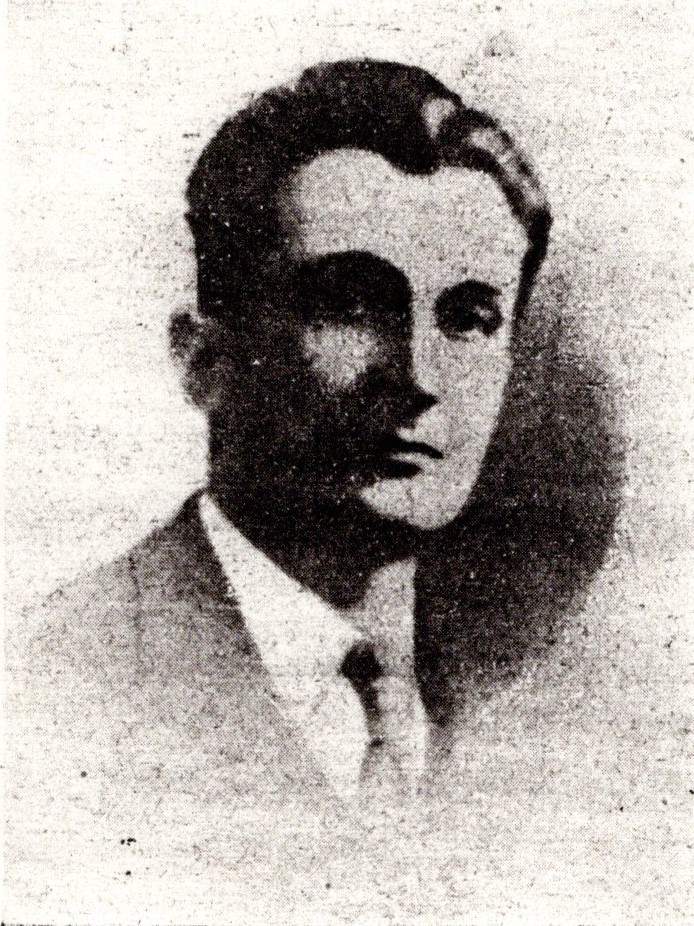
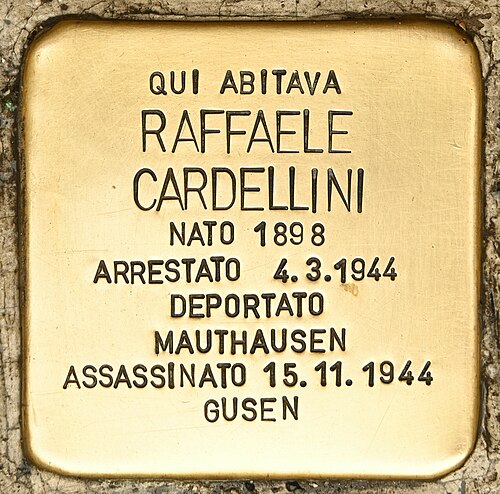
Raffaele Cardellini
Raffaele was born in Offagna (Ancona) in 1898 and moved to Sesto in 1927, immediately after his marriage to Vittoria Scattaini. The couple had two daughters; the youngest was eight years old at the time of her father's arrest.
Raffaele worked as a mechanical locomotive fireman at Falck Concordia Oman in Sesto San Giovanni. Like many Falck workers, after work he frequented the bar near the Dante Cinema (now closed) on Via Falck, where he met with Biffi, Marcanti, and Sistieri: four friends who shared everything—their work at Falck, their deportation, and their death.
Raffaele was the first to be arrested: just as he left the bar on March 4, 1944, three days after the start of the strikes across Northern Italy. After a month in San Vittore prison, he was sent to Bergamo, where a convoy was being formed that gathered those arrested from Turin, Como, Lecco, Brescia, and Genoa—all destined for the Mauthausen camp in retaliation for the strikes. The convoy arrived at Mauthausen on April 16, and Raffaele was assigned to the terrible subcamp of Gusen, nicknamed "the tomb of the Italians," where 1,800 Italians died of exhaustion and hardship.
Gusen extended underground for tens of kilometers in the darkness: tens of thousands of deportees worked in the tunnels under inhuman conditions, never seeing the light of day. Inside, the Nazis sought to produce and develop armaments for the companies Steyr-Daimler-Puch and Messerschmitt.
Raffaele held out for seven months, finally dying of "heart failure and physical decay."
Raffaele worked as a mechanical locomotive fireman at Falck Concordia Oman in Sesto San Giovanni. Like many Falck workers, after work he frequented the bar near the Dante Cinema (now closed) on Via Falck, where he met with Biffi, Marcanti, and Sistieri: four friends who shared everything—their work at Falck, their deportation, and their death.
Raffaele was the first to be arrested: just as he left the bar on March 4, 1944, three days after the start of the strikes across Northern Italy. After a month in San Vittore prison, he was sent to Bergamo, where a convoy was being formed that gathered those arrested from Turin, Como, Lecco, Brescia, and Genoa—all destined for the Mauthausen camp in retaliation for the strikes. The convoy arrived at Mauthausen on April 16, and Raffaele was assigned to the terrible subcamp of Gusen, nicknamed "the tomb of the Italians," where 1,800 Italians died of exhaustion and hardship.
Gusen extended underground for tens of kilometers in the darkness: tens of thousands of deportees worked in the tunnels under inhuman conditions, never seeing the light of day. Inside, the Nazis sought to produce and develop armaments for the companies Steyr-Daimler-Puch and Messerschmitt.
Raffaele held out for seven months, finally dying of "heart failure and physical decay."