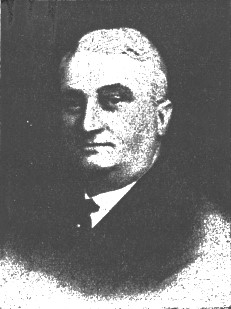
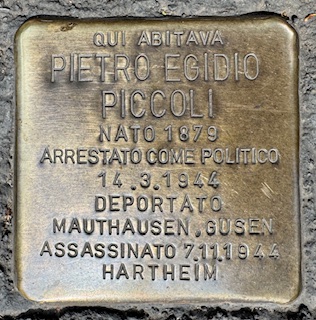
Pietro Piccoli
He was born in 1879 in Belluno. An accountant, he worked in Sesto as a property manager and was known by everyone; "with his witty pen he writes, pleads, achieves, and defends the cause of the poor," as a short article in the newspaper Sesto Proletaria described him after his death.
Ernesto Labellottini, who was with him in San Vittore and during the journey, described him at the moment of his arrest: "I know almost all of them; from Dossena to Barbieri, Valota, Pilloni, Baldanza, and others. I was surprised to see poor Accountant Piccoli among the arrested, a courageous anti-Fascist well known in Sesto, of high moral value—a banner for us younger ones." Indeed, guided by socialist ideals, Pietro had been warning Breda workers who had been flagged after September 8th.
He was arrested at his home on the same date as the Breda opposition, during the night between March 13th and 14th, perhaps due to an internal tip-off at the factory. He shared imprisonment with those he had assisted, as well as the transfer to the Umberto I Barracks in Bergamo and the departure for Germany in sealed wagons; even though he was already an elderly man, he found no mercy from the henchmen.
After being registered with the number 59061, he was sent—like almost all those who arrived on March 20th—to the Gusen II subcamp, which was rapidly expanding due to the arrival of many deportees and where new barracks and war production factories were being built. Pietro proved ill-suited for that labor because of his age: on April 28th, he was sent back to the main camp's Sanitätlager, where those unfit for work were assigned. It was not a medical block; there was no mercy for those who could not work, as the tormentors did not want mouths to feed. After a short time, they would be sent to Hartheim Castle to be killed by gas. This is what happened to Pietro, who officially died there on November 7, 1944, though recent research has shown that the dates provided by the Nazis for these deaths were false cover stories.
Ernesto Labellottini, who was with him in San Vittore and during the journey, described him at the moment of his arrest: "I know almost all of them; from Dossena to Barbieri, Valota, Pilloni, Baldanza, and others. I was surprised to see poor Accountant Piccoli among the arrested, a courageous anti-Fascist well known in Sesto, of high moral value—a banner for us younger ones." Indeed, guided by socialist ideals, Pietro had been warning Breda workers who had been flagged after September 8th.
He was arrested at his home on the same date as the Breda opposition, during the night between March 13th and 14th, perhaps due to an internal tip-off at the factory. He shared imprisonment with those he had assisted, as well as the transfer to the Umberto I Barracks in Bergamo and the departure for Germany in sealed wagons; even though he was already an elderly man, he found no mercy from the henchmen.
After being registered with the number 59061, he was sent—like almost all those who arrived on March 20th—to the Gusen II subcamp, which was rapidly expanding due to the arrival of many deportees and where new barracks and war production factories were being built. Pietro proved ill-suited for that labor because of his age: on April 28th, he was sent back to the main camp's Sanitätlager, where those unfit for work were assigned. It was not a medical block; there was no mercy for those who could not work, as the tormentors did not want mouths to feed. After a short time, they would be sent to Hartheim Castle to be killed by gas. This is what happened to Pietro, who officially died there on November 7, 1944, though recent research has shown that the dates provided by the Nazis for these deaths were false cover stories.