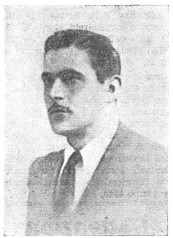
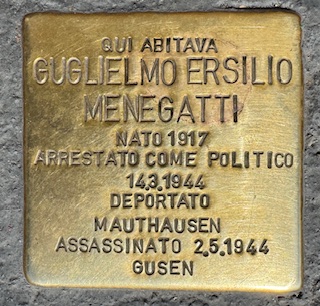
Guglielmo Ersilio Menegatti
Originally from Mesola, in the province of Ferrara, where his father managed a socialist cooperative bar, Guglielmo's family suffered from Fascist harassment in 1922. His daughter recalls: "In '22, the Fascists entered the bar; they beat my uncle, hung my grandmother over the well, tied my aunt to a tree, and destroyed the bar." Consequently, it became necessary to leave: the father found work at Falck as a caretaker, and as soon as the children reached working age, they found employment in various companies in Sesto. Guglielmo joined Breda at age 15 and specialized as a turner.
"We were a quiet, normal family; my dad didn't want us to get involved in politics, he had already been through so much," but on the evening of March 13, 1944, the sound of the doorbell sent everyone into a panic. His brother Antonio, already flagged as a partisan, hid in a bathroom loft; the three Fascists who entered with submachine guns took Guglielmo instead, who was immediately brought to San Vittore.
Violent retaliation was being prepared following the recently concluded strikes. A week later, those arrested were gathered at the Umberto I barracks in Bergamo for deportation to Germany—563 workers from all over Northern Italy: Turin, Milan, Lecco, Varese, Savona, and Genoa. The convoy departed on March 17, and three days later, it was at Mauthausen. The deportees, registered immediately, were almost all sent to Gusen, the massive subcamp where the labor was most brutal.
Guglielmo, who was only 27 years old, was assigned to the heaviest labor, which caused his death from pneumonia within just two months. A letter from the German authorities informed the family that he had died during an Allied bombing raid. The camp documentation proves this to be false.
"We were a quiet, normal family; my dad didn't want us to get involved in politics, he had already been through so much," but on the evening of March 13, 1944, the sound of the doorbell sent everyone into a panic. His brother Antonio, already flagged as a partisan, hid in a bathroom loft; the three Fascists who entered with submachine guns took Guglielmo instead, who was immediately brought to San Vittore.
Violent retaliation was being prepared following the recently concluded strikes. A week later, those arrested were gathered at the Umberto I barracks in Bergamo for deportation to Germany—563 workers from all over Northern Italy: Turin, Milan, Lecco, Varese, Savona, and Genoa. The convoy departed on March 17, and three days later, it was at Mauthausen. The deportees, registered immediately, were almost all sent to Gusen, the massive subcamp where the labor was most brutal.
Guglielmo, who was only 27 years old, was assigned to the heaviest labor, which caused his death from pneumonia within just two months. A letter from the German authorities informed the family that he had died during an Allied bombing raid. The camp documentation proves this to be false.