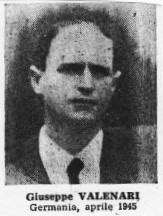
Giuseppe Valenari
Giuseppe Valenari was born in Cologna Veneta, in the province of Verona, on August 26, 1897, and had worked at Breda (Electromechanical Section) since the 1930s. Coming from an anti-Fascist family, he had been a member of the PCI (Italian Communist Party) since its foundation. He was arrested for clandestine activity immediately after the great strike of March '44. His daughter, Natalia, recalled in a testimony the frequent searches, including at night, that the family was subjected to in the hunt for incriminating material. On March 14, during the days when hundreds of workers were being arrested, Giuseppe was also taken from his home by the Fascists at night. They took him to Milan to the San Fedele prison, then to San Vittore, and finally, along with hundreds of other strikers and anti-Fascists, he was handed over to the Nazis who managed the transports to the concentration camps in "Germany."
He departed from Bergamo with 563 other prisoners on March 17 and, after a three-day journey, was registered with the number 59183 as Schutzhaft—a political prisoner arrested for security reasons—at the Mauthausen concentration camp. Mauthausen was a "Category III camp, for detainees held under public security measures, those under heavy suspicion, the incorrigible, the habitual offenders, and 'asocials' unlikely to be susceptible to re-education"—essentially, a camp from which there was no return. A few days later, he was assigned to the horrific Gusen subcamp, where, under extreme conditions, tunnels were excavated for the Nazis to house the Reich's war industries.
Giuseppe managed to endure for only a few months; in October, he was admitted to the Revier—the infirmary/lazzaretto where those who could no longer work were sent. He died there on November 17, 1944. He is one of the 1,700 Italians who died at Gusen: more than half of the 3,000 deported from Italy.
He departed from Bergamo with 563 other prisoners on March 17 and, after a three-day journey, was registered with the number 59183 as Schutzhaft—a political prisoner arrested for security reasons—at the Mauthausen concentration camp. Mauthausen was a "Category III camp, for detainees held under public security measures, those under heavy suspicion, the incorrigible, the habitual offenders, and 'asocials' unlikely to be susceptible to re-education"—essentially, a camp from which there was no return. A few days later, he was assigned to the horrific Gusen subcamp, where, under extreme conditions, tunnels were excavated for the Nazis to house the Reich's war industries.
Giuseppe managed to endure for only a few months; in October, he was admitted to the Revier—the infirmary/lazzaretto where those who could no longer work were sent. He died there on November 17, 1944. He is one of the 1,700 Italians who died at Gusen: more than half of the 3,000 deported from Italy.