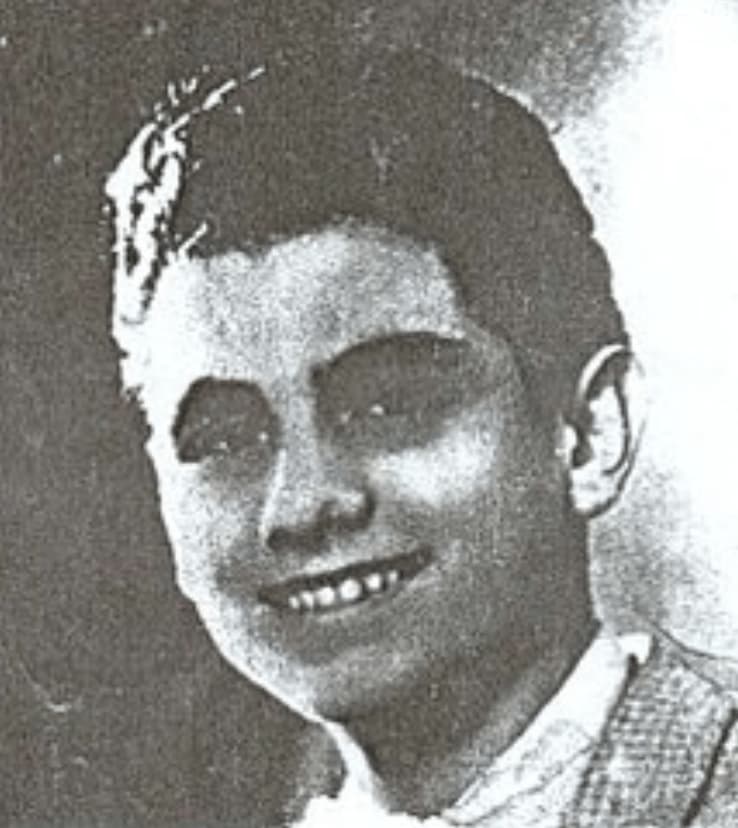
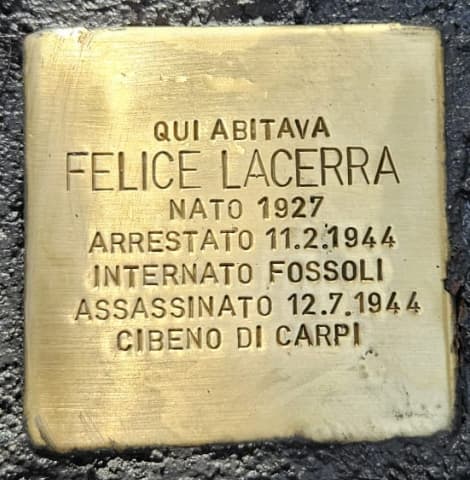
Felice Lacerra
"Felice" (Happy)—perhaps he truly was, with his whole life ahead of him: born in 1927, he was 16 years old and had already been employed for two years as an apprentice at Breda in Sesto San Giovanni. He did not speak of his anti-Fascist ideals with his family to avoid causing them worry, but Felice was a member of the "5 Giornate" Detachment of the III GAP Brigade of Milan. When the Sesto group decided to carry out an attack on the Casa del Fascio (Fascist Party headquarters), Felice was chosen for the role of infiltrator: he joined the Fascist Party, frequented their headquarters, and learned of an important meeting scheduled for February 10, 1944, which he was to attend.
The attack was partially successful. Lacerra should have disappeared, but inexplicably, he returned to work the next day, perhaps believing his cover was sufficient. Instead, he was arrested and imprisoned in the former slaughterhouse of Monza, where he was tortured to extract other names for arrest, and finally sent to San Vittore on February 19. His mother was only able to see him after his transfer to Fossoli, which took place on April 27 from Platform 21 in Milan. His mother, in an interview collected by Giuseppe Valota, says:
"If only all mothers could see what I saw! He was all in rags, they had cut off his beautiful curly hair, his knees were poking out of his trousers."
Felice—serial number 310, barracks 19—arrested for political reasons and marked with the red triangle, spent more than two months in the transit camp, managing to write letters home that were always reassuring. In the last one, dated July 7, he wrote: "Tomorrow morning I will leave Fossoli, the destination I am going to I do not yet know. As soon as I arrive at my destination, I will not fail to give you my news, in any case do not worry as I am very well." This sentence, in its hauntingly broken grammar, written just days before his execution when he still believed he was being sent to Germany, seals the inexorable fate to which the Cibeno massacre condemned 67 prisoners—a fate that only narrowly preceded the transports to Mauthausen that would mark the deaths of so many others. When his body was exhumed, his face unrecognizable due to quicklime, he still had a Breda canteen booklet in his trousers; the slip was dated February 11, the day of his arrest, a day on which he had been unable to eat.
The attack was partially successful. Lacerra should have disappeared, but inexplicably, he returned to work the next day, perhaps believing his cover was sufficient. Instead, he was arrested and imprisoned in the former slaughterhouse of Monza, where he was tortured to extract other names for arrest, and finally sent to San Vittore on February 19. His mother was only able to see him after his transfer to Fossoli, which took place on April 27 from Platform 21 in Milan. His mother, in an interview collected by Giuseppe Valota, says:
"If only all mothers could see what I saw! He was all in rags, they had cut off his beautiful curly hair, his knees were poking out of his trousers."
Felice—serial number 310, barracks 19—arrested for political reasons and marked with the red triangle, spent more than two months in the transit camp, managing to write letters home that were always reassuring. In the last one, dated July 7, he wrote: "Tomorrow morning I will leave Fossoli, the destination I am going to I do not yet know. As soon as I arrive at my destination, I will not fail to give you my news, in any case do not worry as I am very well." This sentence, in its hauntingly broken grammar, written just days before his execution when he still believed he was being sent to Germany, seals the inexorable fate to which the Cibeno massacre condemned 67 prisoners—a fate that only narrowly preceded the transports to Mauthausen that would mark the deaths of so many others. When his body was exhumed, his face unrecognizable due to quicklime, he still had a Breda canteen booklet in his trousers; the slip was dated February 11, the day of his arrest, a day on which he had been unable to eat.