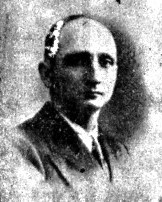
Ettore Pilloni
Emigrated from the Veneto region to Sesto San Giovanni at the age of 26, he married here and had two children, born shortly before the war. He worked at Breda (Section IV) as a turner; his comrades remembered him as a good and honest man.
He was arrested on March 14, immediately after the great strike of March 1944, by men in civilian clothes who arrived at homes at night to capture strikers, as was the case for almost all the anti-Fascists of the Breda CLN. Sent immediately to San Vittore prison, his name appears on the Streikertransport for deportation to Germany. It was a punishment for daring to halt production, but it was also a decision to utilize slave labor for the Reich's war production—people to be exploited without mercy.
On March 17, after only three days, he departed from Bergamo for Mauthausen. Registered on March 20 with the number 59063, he was immediately sent to the Gusen II subcamp, where work was beginning on the construction of the camp and the excavation of a tunnel system to house facilities for the production of weapons and aircraft parts for Steyr-Daimler and Messerschmitt.
The extreme harshness of life and labor led to a rapid physical decline for Ettore: on April 28, he was admitted to the Sanitätslager, the infirmary barracks of the main camp, where he died a few days later on May 4 at the age of 45, leaving behind a wife and two children aged 4 and 6.
He was arrested on March 14, immediately after the great strike of March 1944, by men in civilian clothes who arrived at homes at night to capture strikers, as was the case for almost all the anti-Fascists of the Breda CLN. Sent immediately to San Vittore prison, his name appears on the Streikertransport for deportation to Germany. It was a punishment for daring to halt production, but it was also a decision to utilize slave labor for the Reich's war production—people to be exploited without mercy.
On March 17, after only three days, he departed from Bergamo for Mauthausen. Registered on March 20 with the number 59063, he was immediately sent to the Gusen II subcamp, where work was beginning on the construction of the camp and the excavation of a tunnel system to house facilities for the production of weapons and aircraft parts for Steyr-Daimler and Messerschmitt.
The extreme harshness of life and labor led to a rapid physical decline for Ettore: on April 28, he was admitted to the Sanitätslager, the infirmary barracks of the main camp, where he died a few days later on May 4 at the age of 45, leaving behind a wife and two children aged 4 and 6.