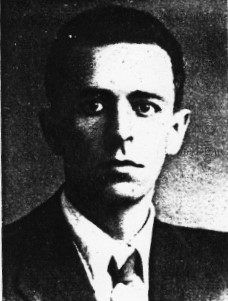
Diego Zanello
Diego arrived in Sesto in 1929 from a small town in the province of Udine, along with his mother and siblings. He worked at Breda (Section II) as a carpenter. We know little about his private life, but we understand his thoughts on Fascism through his participation in the largest strike to occur in Reich-controlled territories. This was immediately followed by harsh repression from the Nazis, supported and aided by the militia of the Republic of Salò.
Diego was arrested at his home on the first night after the strike began. Taken to San Vittore, he was transferred shortly after to Fossoli, a transit camp near Modena—likely because San Vittore was severely overcrowded in those early days due to the numerous ongoing arrests. From Fossoli, he departed in a wagon that was attached to a convoy from Florence, which collected 597 strikers from factories across Northern and Central Italy.
At Mauthausen, Diego was registered on March 11 with the number 57477: thus began his first deprivation. Diego became a number, stripped of all rights; he could only obey, endure hunger, and perform the most grueling labor for 12–14 hours every day, subjected to constant harassment and violence from the SS.
He was soon transferred to the Ebensee subcamp, a brutal labor camp where massive tunnels were being excavated into the mountain to install a factory for tank and truck engine parts. Forced to perform exhausting work in the tunnels under freezing conditions and with miserable rations, deportees survived on average only a few months. Out of a total of 1,131 Italians, 717—a staggering 63%—never returned home. Diego survived until April 21, 1945; he had a strong constitution and was only 34 years old.
Diego was arrested at his home on the first night after the strike began. Taken to San Vittore, he was transferred shortly after to Fossoli, a transit camp near Modena—likely because San Vittore was severely overcrowded in those early days due to the numerous ongoing arrests. From Fossoli, he departed in a wagon that was attached to a convoy from Florence, which collected 597 strikers from factories across Northern and Central Italy.
At Mauthausen, Diego was registered on March 11 with the number 57477: thus began his first deprivation. Diego became a number, stripped of all rights; he could only obey, endure hunger, and perform the most grueling labor for 12–14 hours every day, subjected to constant harassment and violence from the SS.
He was soon transferred to the Ebensee subcamp, a brutal labor camp where massive tunnels were being excavated into the mountain to install a factory for tank and truck engine parts. Forced to perform exhausting work in the tunnels under freezing conditions and with miserable rations, deportees survived on average only a few months. Out of a total of 1,131 Italians, 717—a staggering 63%—never returned home. Diego survived until April 21, 1945; he had a strong constitution and was only 34 years old.