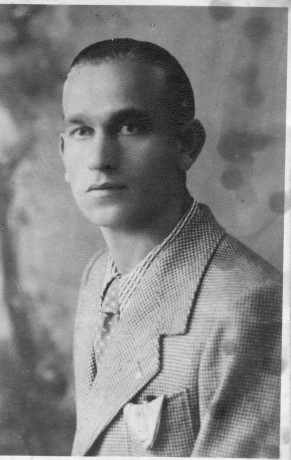
Angelo Villa
He went by the nickname "Fiorita," a playful jest given to him because of his lighthearted character. He lived with his family in a small building behind the railroad, where he used to watch the trains pass by. Since he was a child, he frequented the Circolo Avvenire, and later, as a young man, the "Polo Nord" bar. He was 18 when the Morganti family closed that bar and opened "Caffè Carducci," where Angelo served as a team leader for the "Boni & Fanciulli" football association.
He worked as a tinsmith at Breda (Section V), where he clandestinely distributed L'Unità, Il Combattente, and La Fabbrica, always ready to engage with his comrades. As his involvement in factory sabotage intensified after September 8, '43, his presence in Sesto became increasingly unsafe. Having escaped the arrests during the strikes of March '44, Angelo took to the mountains and was appointed Political Commissar of the 55th Rosselli Brothers Brigade. He led his group in numerous actions in the Lecco area until one night in Introbio, where he was shot three times in the lung. A comrade brought him to safety in a house in Barzio, but a tip-off led to his discovery a few days later.
He spent over a month wounded in San Vittore, always in the infirmary, and while still ill, he was sent to the Bolzano camp. From there, he wrote many letters to his loved ones—always cheerful and hopeful—watching convoys depart and hoping for the arrival of the Allies.
Unfortunately, on January 8, 1945, it was his turn. He tried to escape from the train car by prying off some boards, but he was discovered and brutally beaten. Upon arriving at Mauthausen, he was assigned prisoner number 115773 and immediately sent to the Gusen subcamp. He met his death there at the age of 32; documents suggest he died in the days following the camp's liberation, but his family only received official notification in 1952.
He worked as a tinsmith at Breda (Section V), where he clandestinely distributed L'Unità, Il Combattente, and La Fabbrica, always ready to engage with his comrades. As his involvement in factory sabotage intensified after September 8, '43, his presence in Sesto became increasingly unsafe. Having escaped the arrests during the strikes of March '44, Angelo took to the mountains and was appointed Political Commissar of the 55th Rosselli Brothers Brigade. He led his group in numerous actions in the Lecco area until one night in Introbio, where he was shot three times in the lung. A comrade brought him to safety in a house in Barzio, but a tip-off led to his discovery a few days later.
He spent over a month wounded in San Vittore, always in the infirmary, and while still ill, he was sent to the Bolzano camp. From there, he wrote many letters to his loved ones—always cheerful and hopeful—watching convoys depart and hoping for the arrival of the Allies.
Unfortunately, on January 8, 1945, it was his turn. He tried to escape from the train car by prying off some boards, but he was discovered and brutally beaten. Upon arriving at Mauthausen, he was assigned prisoner number 115773 and immediately sent to the Gusen subcamp. He met his death there at the age of 32; documents suggest he died in the days following the camp's liberation, but his family only received official notification in 1952.