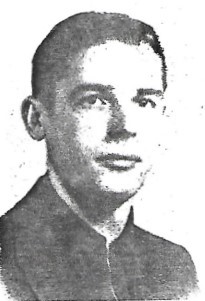
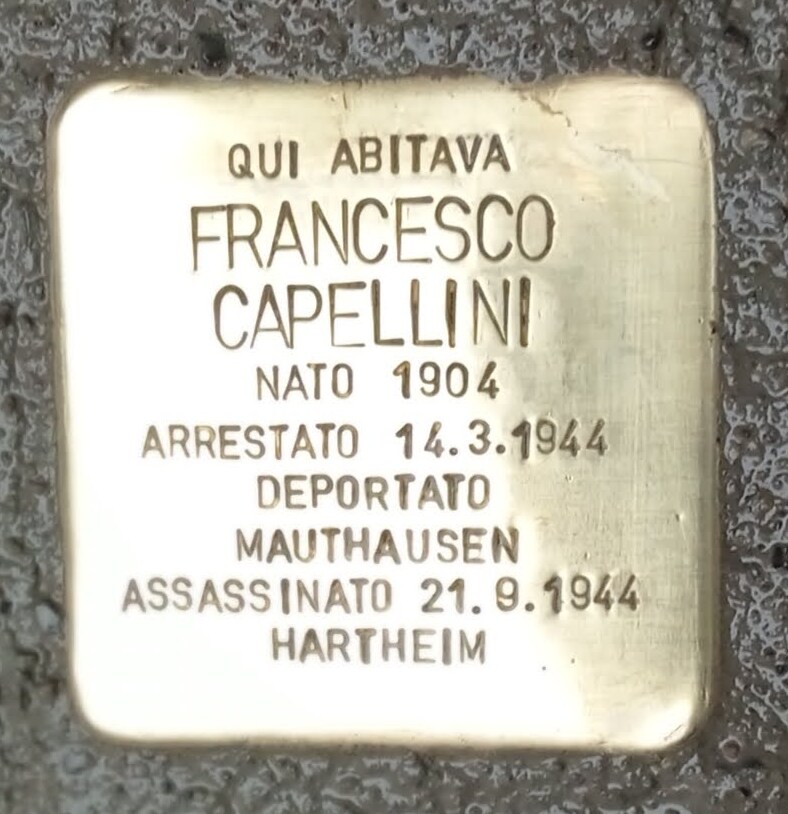
Francesco Capellini
Francesco Capellini was born in Settala (Milan) on December 30, 1904. He worked as a painter in Section V of Breda, but he also earned a diploma in violin from the Monza Music Conservatory. He played extensively in his spare time, taught the instrument to many young people, and accompanied silent film screenings at the Elena Cinema in Sesto San Giovanni, where he lived.
In his family, anti-Fascism was a shared conviction; relatives and friends would gather at his home to listen to Radio London.
He was arrested immediately after the great strike of March 1944: on the night between March 13 and 14, he was taken away by men in civilian clothes and imprisoned first in the San Fedele prison and then at San Vittore. Finally, he was sent to the Umberto I barracks in Bergamo to await the formation of the convoy that departed on March 17, 1944. His wife managed to be present at the train's departure.
Upon arriving at Mauthausen on March 20, he was registered as Schutzhaft (a political prisoner), assigned the red triangle and the number 58768, and sent to the terrible subcamp of Gusen. There, the mortality rate of deportees of all nationalities was extremely high due to the grueling labor in underground tunnels converted into armament factories.
From the moment of Francesco's departure, his family received no further news. It was only in October 1945 that a communication arrived from the Assistance Center for Returnees from Germany, announcing his death on September 21, 1944: Francesco had managed to survive the harsh labor for only six months.
Many years later, the Arolsen Archives (International Center on Nazi Persecution), where documentation from the Nazi camps is preserved, revealed to the family that his death actually took place at Hartheim Castle—an extermination center near Mauthausen. There, prisoners declared unfit or no longer capable of hard labor were murdered using carbon monoxide. Francesco was assassinated at Hartheim along with 300 other Italians at the age of 40.
In his family, anti-Fascism was a shared conviction; relatives and friends would gather at his home to listen to Radio London.
He was arrested immediately after the great strike of March 1944: on the night between March 13 and 14, he was taken away by men in civilian clothes and imprisoned first in the San Fedele prison and then at San Vittore. Finally, he was sent to the Umberto I barracks in Bergamo to await the formation of the convoy that departed on March 17, 1944. His wife managed to be present at the train's departure.
Upon arriving at Mauthausen on March 20, he was registered as Schutzhaft (a political prisoner), assigned the red triangle and the number 58768, and sent to the terrible subcamp of Gusen. There, the mortality rate of deportees of all nationalities was extremely high due to the grueling labor in underground tunnels converted into armament factories.
From the moment of Francesco's departure, his family received no further news. It was only in October 1945 that a communication arrived from the Assistance Center for Returnees from Germany, announcing his death on September 21, 1944: Francesco had managed to survive the harsh labor for only six months.
Many years later, the Arolsen Archives (International Center on Nazi Persecution), where documentation from the Nazi camps is preserved, revealed to the family that his death actually took place at Hartheim Castle—an extermination center near Mauthausen. There, prisoners declared unfit or no longer capable of hard labor were murdered using carbon monoxide. Francesco was assassinated at Hartheim along with 300 other Italians at the age of 40.